Pest control pricing: how to price treatments, plans and inspections
How a pest control business prices one-off treatments, recurring plans, inspections and re-treatments from its own costs, with a worked example.
By Primemgr TeamHow we research and check this
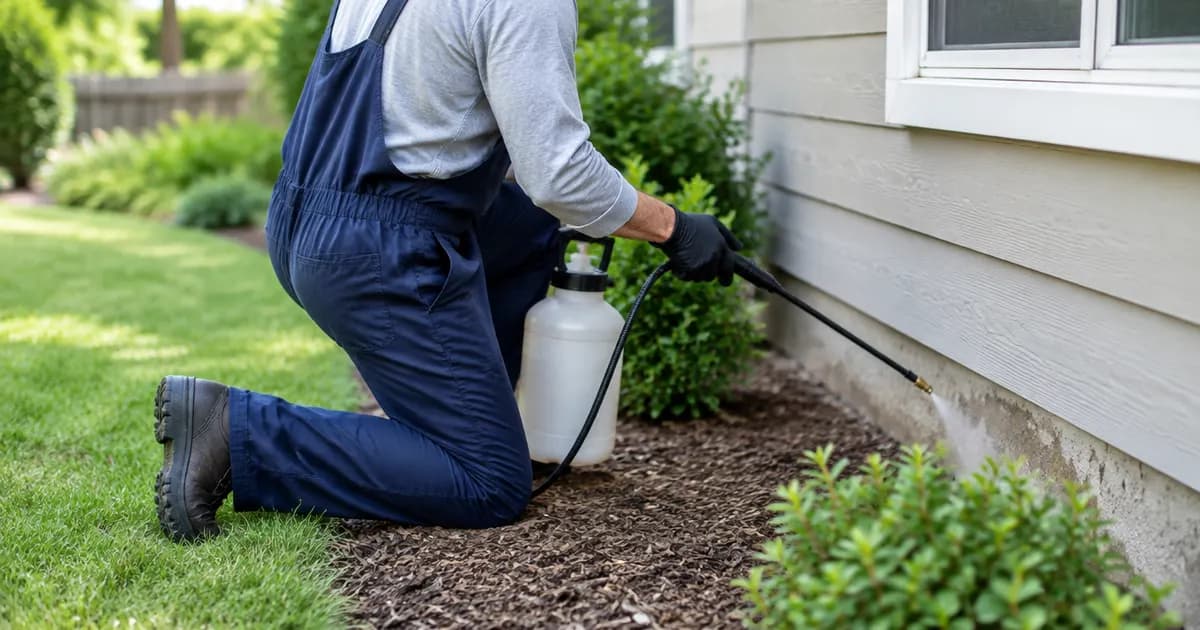
Price pest control from what each visit costs you: labour time at your loaded hourly rate, product used, travel, and a share of overhead, then add your margin. Recurring plans are priced per visit with a small discount for the certainty they give you, and inspections are charged, not given away. This guide is for operators setting their own prices, not for homeowners comparing quotes.
Market rates vary so much by pest, property size, region and competition that copying a published “average price” is a poor start. Your own costs tell you the floor; the market tells you how far above it you can go.
The four things you sell
Service | What it is | How it is usually priced |
|---|---|---|
One-off treatment | A single visit for an active problem | Per visit, by pest and property size |
Recurring plan | Scheduled visits, often quarterly | Per visit or per year, billed monthly or per visit |
Inspection | Assessing a property, for example before purchase | Flat fee by property size |
Re-treatment | A return visit within a guarantee period | Included in the original price, if you offer it |
Step 1: know the cost of an hour
Start with your loaded hourly cost: wages plus on-costs plus overhead, divided by the hours you can actually bill. Travel, loading the vehicle and paperwork are paid hours nobody is invoiced for, so the billable figure is lower than the hours worked. The hourly rate calculator works this out.
Step 2: time each kind of job
Track real times for your common jobs for a few weeks: a general interior and exterior treatment of a standard house, a rodent programme visit, a termite inspection. Include set-up and pack-down. Averages from your own jobs beat any rule of thumb, and they get better every month you keep recording.
Step 3: add product, travel and the margin
A worked example for a general pest treatment on an average house, for illustration only:
Cost | Working | Amount |
|---|---|---|
Labour | 1.25 hours at 70 an hour | 87.50 |
Product and consumables | Measured per treatment | 18.00 |
Travel | 30 minutes and 20 km | 46.00 |
Cost of the job | 151.50 | |
Price at a 25% margin | 151.50 ÷ 0.75 | 202.00 |
The margin divides; it does not multiply. Adding 25% to cost gives only a 20% margin. The profit margin calculator shows the difference on your own numbers.
Adjusting for property size and access
A price that is right for an average house is wrong for a small flat and a large property with outbuildings. Rather than guessing, band your timed jobs by size and set a price for each band:
Band | Example | Typical adjustment to your base job |
|---|---|---|
Small | Apartment or unit | Less time; often a lower price |
Standard | House of average size for your area | Your base price |
Large | Large house, or extra buildings | More time and product; a higher price |
Difficult access | Steep blocks, sub-floors, roof voids | Priced on inspection |
Set the adjustment for each band from your own timings, not a fixed percentage copied from elsewhere. Price anything outside the bands, such as commercial kitchens, warehouses and heavy infestations, by quote after an inspection rather than from the list.
Pricing recurring plans
A plan is worth more to you than the same visits sold one at a time: the work is booked in advance, visits can be grouped by area, and the customer does not shop around each time. That justifies a modest per-visit discount, but not a loss. Work out the per-visit cost as above, apply a smaller margin reduction than your one-off price, and check that the plan still covers a callback between visits if you promise one.
- State how many visits the price includes and roughly when.
- Say what happens if a pest returns between visits: included, or charged at a reduced rate.
- Decide how the plan ends and how the customer is reminded before it renews.
- Put it in writing with a service agreement.
Inspections and quotes
A thorough inspection takes skilled time and often produces a written report. Charge for it as its own service rather than burying it in a free quote. Many operators credit part of the inspection fee if the customer books the treatment. For call-outs to assess a problem, the same thinking applies as in setting a call-out fee.
Guarantees and re-treatments
A guarantee is a cost you sell in advance. If one in eight general treatments needs a free return visit, the price of every treatment has to carry one-eighth of a visit. Track re-treatments by job type; if the rate climbs, the cause is usually the treatment, the product or customer preparation, and the price is only the symptom.
Mistakes that cost operators money
- Quoting by the pest alone, ignoring property size and access.
- Free inspections that turn into hours of unpaid work.
- Plans discounted so far that the callbacks they include wipe out the margin.
- Never reviewing prices as wages, fuel and product costs rise.
Running it in Primemgr
The pest control pack adds fields to each job for the target pest, the product applied, the areas treated and the safe re-entry time, alongside the treatment record template. Recurring plans run as service agreements that raise each visit a set number of days ahead, and the job profitability report compares what you billed with the cost of the items billed. You can try it free for 14 days on your own jobs: see pricing.
Official guidance
- How to get certified as a pesticide applicator (U.S. EPA)
- Pest control workers (U.S. Bureau of Labor Statistics)